by Bernard Magee
Duplicate Pairs is the game most of you play in your clubs, but considering a lot of players learn in a rubber bridge style, there are a lot of tactics that you need to know to the make the most of your cards. The DVD starts by dealing with declarer play and the importance of overtricks.
Here is a classic type of hand:
You are West, declarer in 3NT after the straightforward auction of 1NT–3NT. North leads the ♠️5 to South’s queen and you have to plan your play.
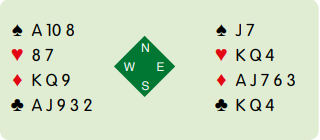
You have eleven top tricks as long as the minors break reasonably, so that means you should aim for a twelfth. Win your ♠️A and play a heart at trick 2. North is very likely to duck if he holds the ace, but South might even duck too. By playing it so early in the play the defenders will hopefully not suspect that you have running tricks. If they do duck the heart trick, you run for home, making 12 tricks: 10 in the minors, the ♠️A and the ♥️K.
Your score will be the one that is commented on when people look at the traveller – how on earth did they make 12 tricks, there are two obvious losers? However, from the defenders’ point of view they are not necessarily aiming for just two tricks, so it is not unreasonable for them to duck once. Clearly if declarer took his 10 tricks in the minors after the ♠️A then the defence will take their ♥️A and their spade trick. Making 3NT+2 will score below average. 3NT+3 will be a very good score indeed – there will be very few people in a minor suit slam even though 6♣️and 6♦️are good contracts.
I show the travellers and explain why scoring an extra 30 points can be so important, let alone 10 points.
In the second half of the DVD, I turn to the subject of defence. One example is similar to the one above, but from the defence’s perspective. When you see a strong dummy, then you should tone down your objectives: rarely, unless your lead hits gold dust, will you defeat the contract if declarer has 28-30 points between his two hands.
By being aware of your aims, you can sometimes settle for two or three tricks and the saving of an overtrick will get you a good score.
Perhaps the most important aspect of pairs defence is playing safe – trying not to give away tricks with careless leads or switches.
What do you lead from this West hand after the auction 1NT–3NT?
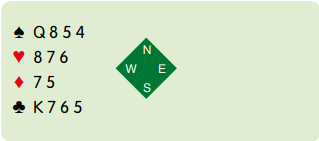
We are generally taught to lead the fourth highest from our longest and strongest, but these rules stem from rubber bridge, where attacking leads are the name of the game – overtricks don’t matter and the aim is to be active trying to make extra tricks. In duplicate bridge, that is rarely your aim; a good lead is a lead that gives nothing away and leaves to declarer to establish his own extra tricks.
A five-card suit is a reasonable lead because you have the chance of making extra tricks, but weak four-card suits are rarely good leads because they risk giving away a trick with very little to gain. A strong four-card suit (with two high cards) is reasonable because with one honour from partner you may well develop the suit, but when one honour from partner will not help sufficiently you should look elsewhere.
The key thing to remember is that you are in a partnership and there is the chance that you might be able to find your partner’s suit. Avoiding a club or spade lead from this hand, I would choose the major over the minor because majors are more likely to have been bid. Lead the ♥️
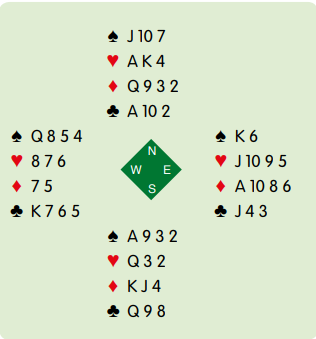
The lead is not dynamic, but it gives nothing away and forces declarer to do his own work. Declarer might win in dummy and lead the ♠️J covered by the king and ace. The defence continue hearts each time they get the lead and might even get declarer down if he is forced to open up all the suits himself.
A diamond lead works as well, but leading your weak four card suits works out very badly. A spade lead will give a trick away when dummy follows with the ♠️7 and a club lead might even give declarer three club tricks. East may well play the jack at trick one allowing declarer to finesse for your king.
Duplicate pairs is a great game, but getting used to the scoring system and the tactics that profit the most is so important and will result in much improved scores